
Cornerstone guide
Pruning vs Removal — How to Decide What Your Aurora Tree Actually Needs
Most homeowners walk into this decision either too fast (remove it, just to be done) or too slow (keep nursing a tree that's already structurally lost). Here's the framework an Aurora arborist actually uses on a quote visit. Updated 2026.
- Free written quotes
- Fully insured + WSIB
- ISA-certified partners
- Aurora bylaw permits handled
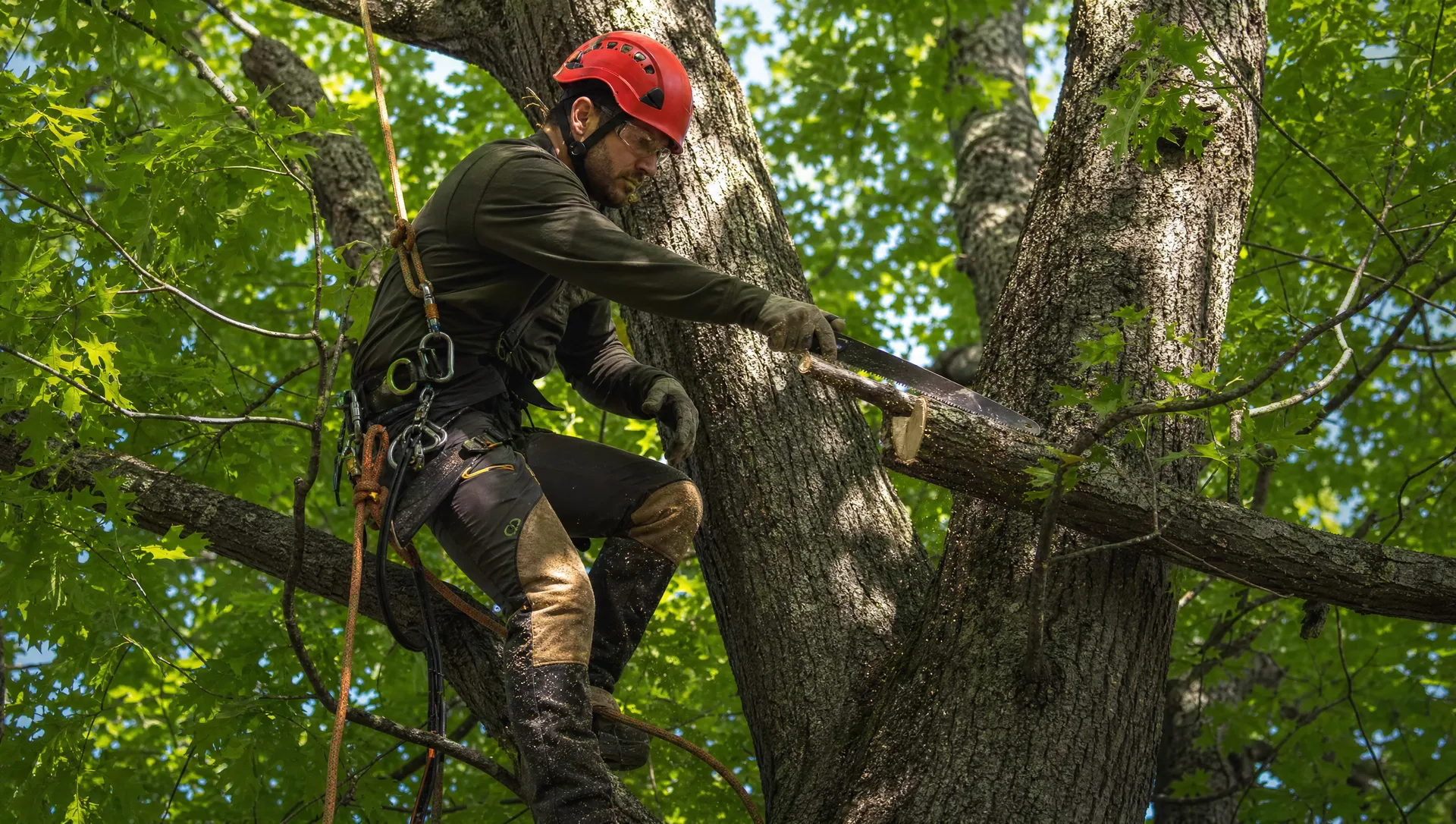
The short version
Pruning is correctable harm. Removal is permanent.
That's the asymmetry to keep in mind. A pruning mistake heals in two or three seasons; the wrong removal is a 40-year delay before the spot has shade again. So the default bias should be toward pruning — if the tree is structurally sound enough to respond to it.
The trick is honestly answering that "if". Most trees Aurora homeowners want to remove (overgrown, dropping leaves on the driveway, blocking the satellite dish) can actually be pruned. Most trees they want to save (storm-damaged, leaning, looking sad) can be too — but a meaningful minority cannot, and pruning those just postpones the same removal at higher cost and with more risk. This guide is the framework for telling those apart.
The four questions an arborist runs through
Every quote visit for a tree the homeowner is unsure about works through the same four questions. You can apply them yourself before we even arrive:
- Is the tree dead, dying, or imminently hazardous? If yes, the decision is made — removal under the bylaw's hazardous-tree exemption. No paperwork, no permit fee. (Documentation still matters; we provide it.)
- If not dead, is the structural defect repairable through pruning within ANSI A300 limits? The industry standard caps single-visit canopy reduction at 25% for mature trees. If fixing the problem requires more than that, the tree was already on the wrong side of the line before we got there.
- Does the tree's location make it impractical to keep? A perfectly healthy tree in fundamentally the wrong spot — under a service drop, against a foundation, between two driveways — is a recurring maintenance problem that no amount of pruning permanently resolves.
- What's the ten-year cost difference? Pruning is cheaper per visit but recurring; removal is more expensive once but final. The honest comparison isn't "$500 prune vs $2,500 removal" — it's "$500 every three years for 30 years vs $2,500 plus a $300 replacement tree."
When pruning is the right answer
Five common scenarios where we recommend pruning over removal, regardless of how the tree looks at first glance:
- Routine canopy management. Thinning to improve light penetration, airflow, or wind resistance. Mature healthy trees benefit from this every 3-5 years.
- Storm damage where less than 40% of the canopy was lost. Most trees recover from this level of damage with corrective pruning and 1-2 growing seasons. The visible mess is usually scarier than the structural reality.
- Clearance pruning — raising the canopy for vehicles, deadwooding over driveways, opening sightlines at the end of a driveway, clearing limbs off roof or eaves.
- Young-tree structural pruning on trees under 15 years old. This is the highest-leverage tree work there is — a few correctly-placed cuts now prevent codominant-stem failures 20 years from now.
- Crown reduction in the 10-25% range on trees that are simply outgrowing a tight spot. Buys time without compromising the tree's long-term health, especially valuable for heritage trees on Aurora's older lots.
When removal is the right answer
Five scenarios where pruning isn't enough — and where waiting usually makes the eventual removal harder, not easier:
- EAB-infested or EAB-killed ash trees. Once visible symptoms are present, the tree is on a 3-5 year decline timer. Pruning doesn't arrest infestation. See our EAB guide for the full picture.
- More than 50% canopy loss with no green growth from major scaffold limbs. Below 50%, recovery is realistic; above 50%, the photosynthetic deficit is usually unrecoverable, especially in older trees.
- Codominant stems with included bark on mature trunks — the bark trapped between two stems prevents wood from fusing them together, and the joint is mechanically weak. On young trees this can be pruned out; on mature trees with large-diameter codominants, the failure is structural and not repairable.
- Heavy root rot or trunk decay. Mushroom fruiting bodies at the root flare (especially Armillaria or Ganoderma species), large cavities at the base, or hollow tap-test sounds at chest height. The structural integrity is already compromised internally; cutting the canopy doesn't fix the base.
- Trees planted in fundamentally wrong locations. Norway maples next to driveways, willows over septic fields, silver maples against foundations — the underlying conflict will recur no matter how much pruning happens. Replace with a properly-scaled species.
The gray-area calls
The decision is rarely as clean as the lists above. Three gray-area situations that come up regularly on Aurora quote visits:
Construction-damaged trees
Recent driveway, septic, or foundation work near a mature tree often damages root systems invisibly. The tree may look fine for 2-4 years before declining. If you've had construction work within 30 metres of a mature tree in the last five years and the canopy is now thinning, the cause may already be in motion. Pruning helps in the short term; if more than a third of the root zone was disturbed, removal within the next 1-3 years is often the realistic answer. We tell you what we see and let you make the call.
Heavy lean post-storm
A new lean that wasn't there before the storm is a different situation from a tree that has gradually leaned over decades. Signs that the new lean is a structural emergency: cracked or heaved soil on the uphill side, exposed and torn roots on the downhill side, more than ~15 degrees of new lean. Any of those, removal is non-negotiable. If the lean is modest and the soil and root plate look undisturbed, the tree is often recoverable. We bring a soil probe to every storm-damage assessment and check the root plate before quoting.
Mature trees outgrowing residential lots
This is the most emotionally difficult call. A 60-year-old front-yard maple that's become too big for the space is still a magnificent tree — but the recurring pruning bill, the roof clearance issue, and the seasonal mess add up. There is no objectively correct answer here. What we provide is honest numbers: the 10-year cost of pruning to manage size vs. the cost of removal plus a smaller replacement species that fits the spot indefinitely. Most homeowners pick a side once they see the dollar figures rather than the emotional framing.
What it costs in Aurora — pruning vs removal
Typical 2026 pricing for mature trees on private residential property in Aurora, Newmarket, Richmond Hill, and King City:
- Light pruning (deadwooding, clearance, modest thinning): CAD $300-$600 per visit.
- Structural pruning (codominant correction, crown raising, restoration after topping): $600-$1,200 per visit.
- Crown reduction (15-25% canopy reduction for size management): $800-$1,500 depending on tree size and complexity.
- Tree removal (most mature residential trees): $1,000-$3,500. See our detailed pricing guide for what drives the variance.
- Stump grinding (typically removal add-on): $150-$600.
- Replacement tree planting: $300-$700 for a 6-10 ft caliper specimen of an appropriate species.
For the ten-year cost comparison: a tree pruned every 3 years for 30 years runs $3,000-$9,000 cumulative; one-time removal plus replacement runs $1,500-$4,500 plus modest care on the new tree for 5-10 years. Per-decade, the curves often cross. The right answer depends on whether the existing tree is worth preserving on its merits — canopy size, shade, ecology, character.
The Aurora bylaw angle: pruning is unregulated, removal is not
One angle that often tips the decision: under Aurora's Private Tree Bylaw 6362-21, pruning of any tree on private property is unregulated — no permit, no fee, no waiting period. Removal of a healthy tree 20 cm DBH or larger requires a permit, the associated fee, and often a replacement-tree obligation. (Dead, dying, hazardous, and certain invasive non-native trees are exempt from the permit requirement. The full breakdown is in our permit guide.)
Practically, this means an aggressive but ANSI-compliant pruning is procedurally faster to schedule than a removal of the equivalent tree. If you're trying to handle a problem before a property sale or a property line dispute, that timing gap matters — pruning can happen this week; a permit-required removal can take 14-30 days from application to approval, and Heritage Conservation District work can take 4-8 weeks.
How we approach the call on a quote visit
Every quote visit follows the same pattern, with documentation provided either way:
- Visual assessment of the canopy — deadwood percentage, foliage colour, branch architecture, signs of pests or disease.
- Trunk and root flare inspection — cavities, fungal fruiting bodies, included bark, surface root damage, soil heave.
- Sound test on the lower trunk — rubber mallet at chest height. Solid wood resonates; hollow areas sound dull.
- Site context review — what's nearby (structures, lines, neighbour's property), what the tree is doing or threatening to do, what species it is and how that species typically fails.
- Two options in the written quote when the call is genuinely close: a "prune now, reassess in 3 years" path and a "remove and replant" path, with the 10-year cost comparison spelled out.
We don't default to removal because removal jobs are bigger and more profitable. We default to "what does this tree actually need, and what's the long-run cost honestly?" because that's how repeat business gets built in a town the size of Aurora. The arborist who recommends pruning when pruning is right is the one called back when removal is genuinely needed.
The 25% rule (and why "topping" is never the answer)
If you remember one rule from this guide: never accept a quote that involves removing more than 25% of a mature tree's canopy in a single visit. Above that threshold, the tree experiences photosynthetic shock, decay-fungi entry at large cut sites, and a regrowth response of water sprouts — weakly-attached vertical shoots that look like recovery but are structurally worse than what was cut.
"Topping" — cutting all major leaders back to indiscriminate stubs — is the most common form of this violation. It's still offered by unlicensed crews because it looks aggressive and feels like value for money. It is the single most damaging thing that can be done to a tree short of removal, and the resulting structural problems make eventual removal more dangerous and more expensive. Any quote that involves topping is a quote to walk away from.
The honest summary
Default to pruning unless you can clearly identify one of the five removal triggers above. Get a second opinion on close calls — a free quote visit costs nothing and a second arborist's eye is the most reliable way to make the right decision on a tree you'd like to save. Be skeptical of any quote that involves topping, removing more than 25% of canopy in one visit, or removing a healthy tree without the underlying reason being clearly explained.
And when the answer genuinely is removal — for an EAB ash, a structurally compromised maple, a wrong-location norway — that's not a failure of stewardship. It's the responsible call. Plant something better-suited in the spot, and the next 40 years take care of themselves.
Pruning vs removal questions
Common questions Aurora homeowners ask before deciding
How do I know if my tree needs pruning or removal?
Start with three questions: (1) Is more than 50% of the canopy dead, broken, or diseased? If yes, removal is usually the answer — recovery from that much loss is unreliable. (2) Are there structural defects you can see from the ground — heavy lean, large cavities, codominant trunks with bark trapped between them, exposed root flare with decay? Two or more together usually means removal. (3) If the tree were healthy in this location, would you want it to stay? If yes and the defects are repairable, prune. If no — wrong species, wrong spot — even a healthy tree may be worth replacing. A quote visit from an ISA-certified arborist is free and is the most reliable way to know.
Is pruning always cheaper than removal?
Up front, almost always. A single pruning visit in Aurora typically runs CAD $300-$1,200; a removal of the same tree runs $1,000-$3,500 plus $150-$600 for stump grinding. But pruning is recurring — well-maintained trees need attention every 2-5 years — so the ten-year cost is closer to even. The real cost calculation isn't pruning-vs-removal price; it's "is this tree worth investing in for the next 30 years." If the answer is yes, prune. If it's a tree that's going to be a maintenance problem indefinitely, the cheaper long-run answer is often removal plus replacement with a species that fits the spot.
Do I need a permit to prune a tree in Aurora?
No. Aurora's Private Tree Bylaw 6362-21 covers removals of healthy trees 20 cm DBH or larger — pruning is exempt regardless of tree size. The exception is heritage-protected trees in Aurora's two Heritage Conservation Districts, where some pruning above a certain percentage of canopy can fall under the Ontario Heritage Act. For any normal residential pruning, no permit is needed. (See our permit guide for the full bylaw breakdown.)
Can heavy pruning kill a tree?
Yes — and this is the most common avoidable mistake we see in Aurora. The industry standard is ANSI A300, which caps single-visit canopy reduction at 25% for mature trees (less for stressed ones). "Topping" — cutting back to indiscriminate stubs — is never appropriate and causes long-term decline, decay entry, and dangerous water-sprout regrowth. If a homeowner or unlicensed crew has previously topped a tree on your property, the right move is usually not more aggressive cutting; it's either restorative pruning over several years or removal if the structural damage is too far along.
My tree was damaged in a storm — does it need to come down?
Usually not, but it depends on three factors: (1) what percentage of the canopy was lost, (2) whether the trunk or major leaders are split, and (3) whether the root plate has lifted. A tree that lost 30-40% of its canopy to broken limbs but has an intact trunk and stable roots is almost always saveable through corrective pruning. A trunk split or lifted root plate is usually structural — even if the tree looks otherwise alive, the failure has already begun. For Aurora storms in particular, the bigger risk is hung limbs that didn't finish falling — those need to come down promptly regardless of whether the whole tree stays. See our storm damage page for what we cover.
My tree is leaning. Does that mean it has to be removed?
Not by itself. Mature trees lean naturally — toward sunlight, away from prevailing winds, or after years of asymmetric crown growth. A leaning tree that has been leaning for years and shows no soil disturbance at the base is usually stable. The danger sign is a new lean that wasn't there before, especially with cracked or heaved soil on the uphill side or exposed roots on the downhill side — that's root-plate failure, and removal is the only safe response. A second danger is a lean of more than about 15 degrees from vertical in a tree that didn't grow that way; that often indicates wind damage to anchor roots even without surface signs.
What about a tree that's getting too big for its location?
This is the most common gray-area call we get in Aurora. Mature street and front-yard trees that were planted close to houses 40-60 years ago are now hitting roof lines, dropping limbs on driveways, or shading entire front yards. The honest answer: aggressive pruning can buy time, but it doesn't solve the underlying problem — the tree wants to be bigger than the spot allows. If you're going to spend $600-$1,000 every 3 years on size-control pruning forever, the math eventually favours removal and replanting with an appropriately-sized species (Japanese maple, redbud, serviceberry, ironwood, or a properly-scaled native). We give you both numbers in the quote so you can make the call with full information.
Not sure which your tree needs? Get an honest written assessment.
Free site visit by an ISA-certified arborist. Written quote within 24 hours, with both prune and remove options spelled out when the call is close.
Or call us: (807) 788-1015